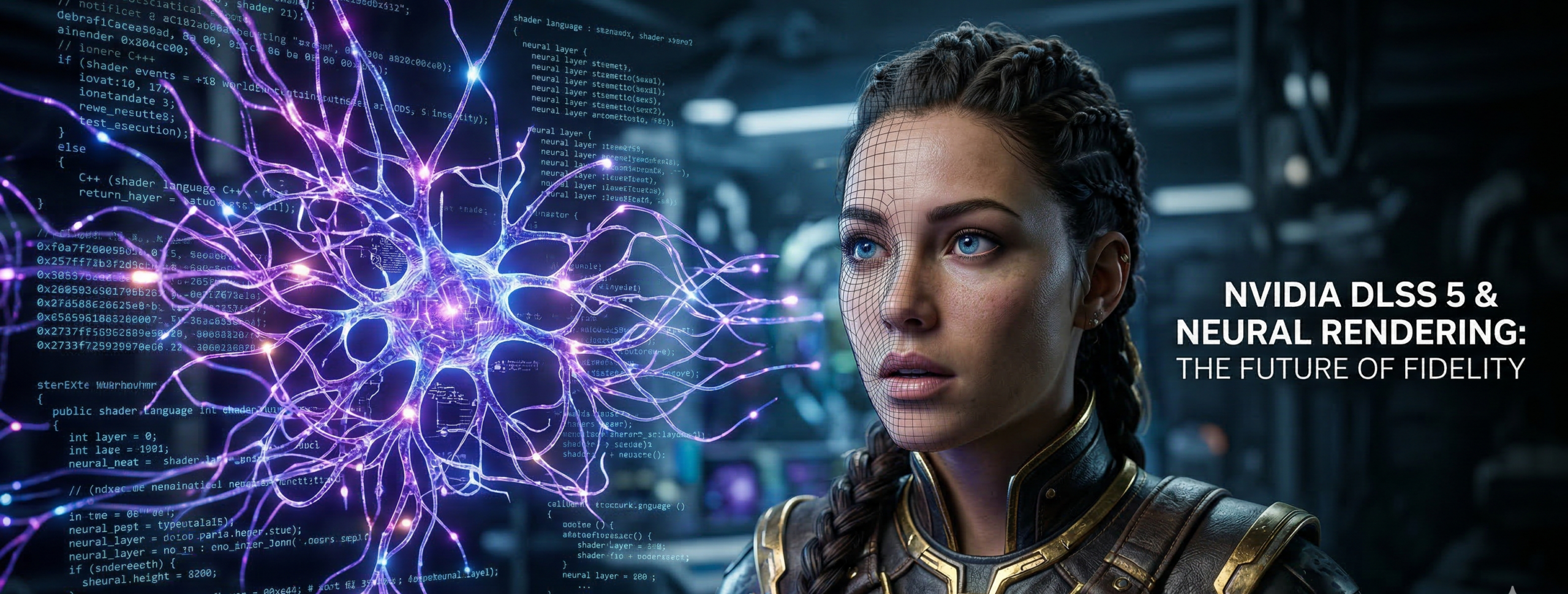
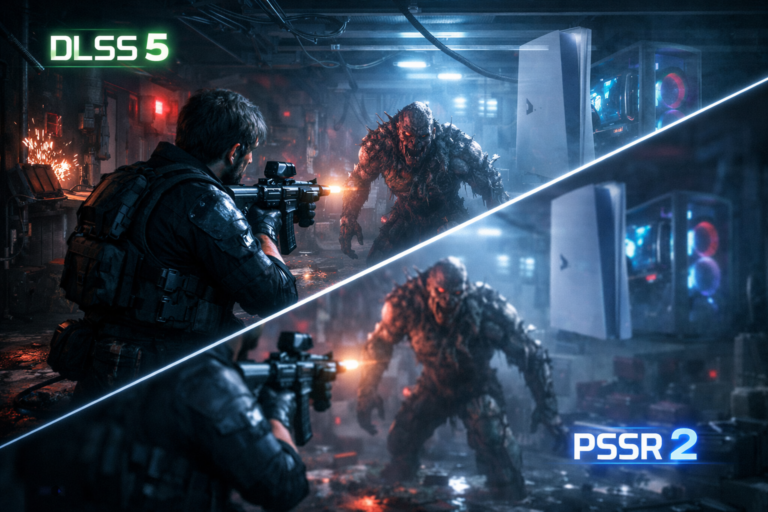
If you thought DLSS was just about upscaling pixels or “faking” frames, think again. At GTC 2026, Jensen Huang officially unveiled DLSS 5, and it’s a fundamental shift in how your GPU works. NVIDIA is calling it the “GPT moment” for graphics, moving away from brute-force rendering and toward a real-time Neural Rendering model. For the first time, AI isn’t just helping your game run faster—it’s actually “re-imagining” lighting and materials in real-time to bridge the gap between gameplay and Hollywood-grade VFX.
It’s Not Just Upscaling Anymore: Unlike DLSS 2 or 3, which focused on resolution and frame rates, DLSS 5 is a Neural Rendering Model. It uses AI to “infuse” pixels with photorealistic lighting and textures (like subsurface scattering on skin or the sheen on fabric) that standard shaders can’t calculate in real-time.
The “Uncanny Valley” Killer: NVIDIA showed demos of Resident Evil Requiem and Starfield where character faces looked strikingly human. By analyzing scene “semantics,” the AI understands it’s looking at a face and applies realistic skin imperfections and pupil reflections that were previously impossible at 60+ FPS.
Blackwell is the Key: While it hasn’t been fully confirmed for older cards, all the GTC demos were running on RTX 50-series (Blackwell) hardware. The heavy lifting is likely tied to the new dedicated Neural Shader cores found in the 5090.
Deterministic Content: One big “miss” in the news is that DLSS 5 is deterministic. This means the AI isn’t just “hallucinating” details; it’s anchored to the game engine’s motion vectors, ensuring the image remains stable and consistent from frame to frame.
Developer “Artistic Control”: Critics are calling it “AI Slop,” but NVIDIA has built in a “Streamline” framework. This gives developers a “dial” for intensity, color grading, and masking, so the AI won’t accidentally ruin the game’s original art style.
This video was published just two days ago and showcased DLSS 5 in titles like Resident Evil Requiem, Hogwarts Legacy, Starfield, and FC26.
Here is a summary of the technical highlights:
Neural Rendering Technology: Unlike previous versions, DLSS 5 focuses on AI-powered visual fidelity using neural rendering.
Real-time Geometric Reconstruction: The AI can now reconstruct complex geometric details and textures in real-time, such as hair, lighting, and environmental effects.
Impact on Fidelity: The video demonstrates a drastic difference in visual quality when toggled on, especially in complex areas like water reflections, facial details, and cloth physics.