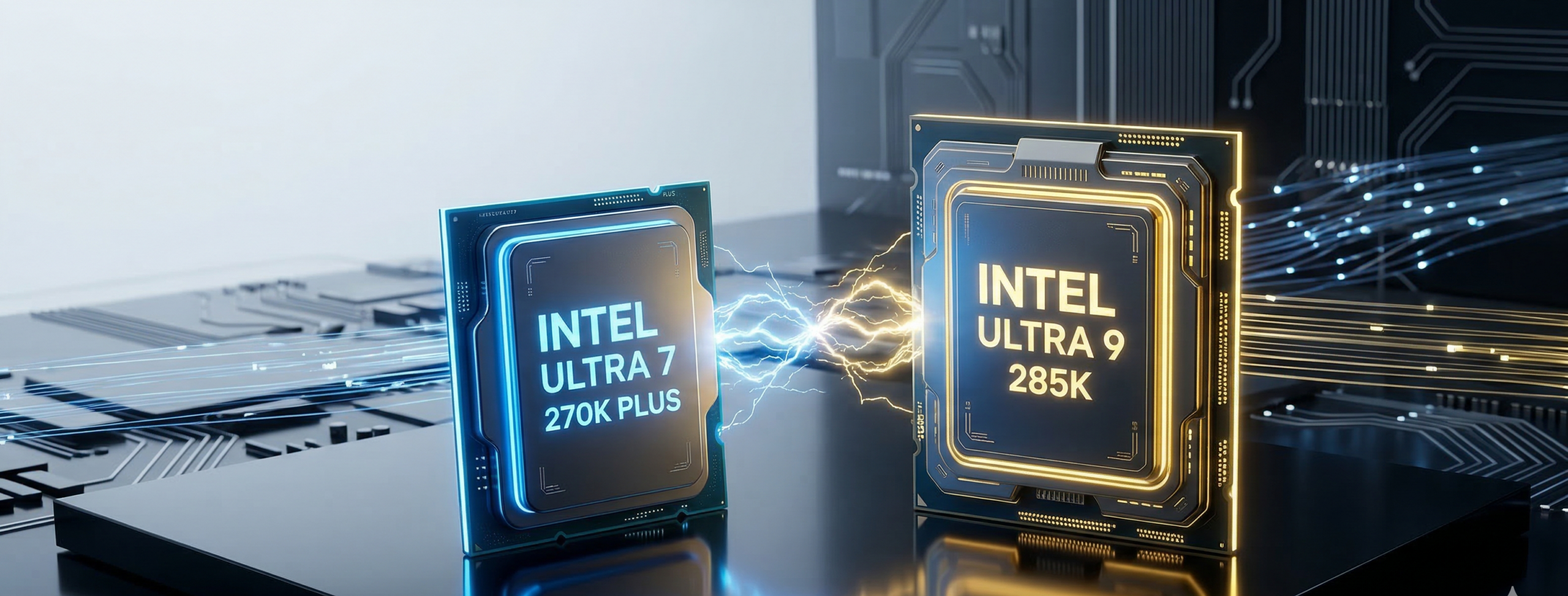
The Angle: Intel just announced the Core Ultra 200S Plus series (270K Plus and 250K Plus) launching March 26th.
The Technical Core: Why “Plus” Matters
The headline isn’t just “more cores”; it’s the 900MHz boost to the “Die-to-Die” (D2D) interconnect.
- The Latency Fix: In the original chiplet design, the link between the CPU cores and the memory controller was a bottleneck. By cranking this link from 2.1GHz to 3.0GHz, Intel is effectively lowering the “tax” of moving data between chiplets.
- The Result: Intel claims this architectural tweak, combined with faster memory support, delivers a 15% geomean gaming uplift over the non-Plus versions.
The “Value King”: Ultra 7 270K Plus vs. Ultra 9 285K
This is the most controversial part of the report. The new $299 Ultra 7 270K Plus now matches the core count of the $589 Ultra 9 285K (8P + 16E).
- The Spec War: The only thing separating the 270K Plus from the flagship 285K is a mere 200MHz on the boost clock and the lack of the “Thermal Velocity Boost” algorithm.
- The Disruption: For nearly half the price, you are getting essentially the same silicon. Intel has officially cannibalized its own flagship to stay competitive with AMD’s Ryzen 7 9700X and 9800X3D.
The “Secret Weapon”: Intel Binary Optimization Tool (IBOT)
Intel is introducing a new software layer called IBOT.
- What it does: It’s an on-the-fly optimization tool that improves Instructions Per Cycle (IPC) even for games that weren’t specifically optimized for Intel’s hybrid architecture.
- The Impact: Early leaks suggest that in games like Shadow of the Tomb Raider, turning on IBOT can lead to performance gains as high as 39%.
Memory Revolution: 4-Rank CUDIMMs
For your “Resources” or “Specs” section, mention that these chips are the first to officially support 4-Rank CUDIMM memory.
- This allows for insane density—up to 128GB per individual RAM stick.
- It also officially bumps the “out-of-the-box” speed support to DDR5-7200, with a BIOS-backed warranty up to 8000 MT/s.