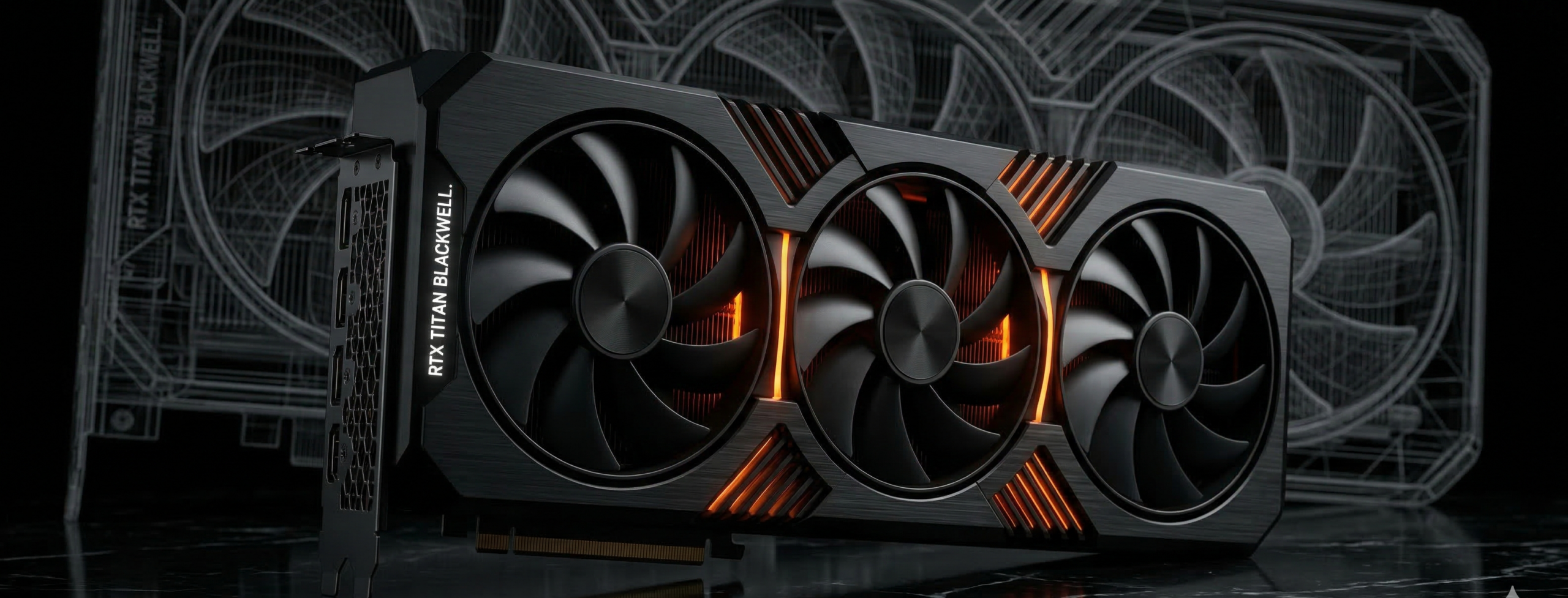
The Angle: Leaks from this week (March 18) suggest NVIDIA is working on a “Very High End” halo card for Q3 2026.
The “Full Fat” GB202 Die
The current RTX 5090 is an absolute monster, but it’s actually a “cut-down” version of the flagship Blackwell silicon.
The CUDA Core Gap: The 5090 uses 21,760 CUDA cores. The rumored TITAN would use the “full fat” GB202 die, unlocking all 24,576 cores. That is a 13% increase in raw compute power alone.
The 1,000W Prototype: Leaked engineering samples from late 2025 and early 2026 suggest this card is so power-hungry that prototypes were seen with two 12V-2×6 power connectors. While the “standard” TDP might be 700W, unlocked versions could technically draw over 1,000W.
The VRAM Dilemma: 32GB vs. 48GB
This is the hottest point of debate for SpecRuns.
The Current Spec: The 5090 has 32GB of GDDR7.
The TITAN Spec: Rumors suggest NVIDIA is testing two versions: a 32GB version with faster 32Gbps modules (hitting 2 TB/s bandwidth) and a massive 48GB version.
The Conflict: A 48GB “gaming” card would directly compete with NVIDIA’s $9,000 RTX PRO 6000 Blackwell. To protect their professional margins, NVIDIA might limit the TITAN to 32GB but with much higher clock speeds to keep it “exclusive”.
Why Now? The “Super” Cancellation
The reason this TITAN rumor is gaining steam is that the RTX 50-series “SUPER” refresh has reportedly been cancelled or indefinitely paused due to global memory shortages.
Instead of a broad mid-gen refresh, NVIDIA is reportedly pivoting to a limited “Founders Edition-only” launch in Q3 2026.
This allows them to sell high-margin “Halo” chips to the “global elite” (collectors and AI researchers) without needing the massive volume required for a 5080 Super or 5070 Super.
Testing the RTX 5090 vs the TITAN prototype This video provides a deep technical analysis of the leaked specs and discusses the possibility of the 48GB vs 32GB VRAM configurations.